If you have spilled liquid on a MacBook in Almaty, power it off immediately, disconnect the charger, tilt it so the liquid drains away from the keyboard, and do not turn it back on. iServices offers free 15-minute diagnostics in front of you, board repair under a microscope, and a warranty up to 1 year.
The First Ten Minutes After a Spilled Liquid MacBook Accident
The first minutes decide how far the liquid travels inside the machine, and speed matters more than any folk method you may have read about. Here is the sequence we walk customers through, step by step.
Service details: “MacBook liquid damage repair”.
What to do in the first 60 seconds
Power the MacBook off at once, unplug the charger and any accessories, then tilt the machine so liquid runs out of the keyboard side and away from the logic board. Hold it at a shallow angle with the screen open and the keys facing down, and let gravity pull the spill outward instead of deeper. Do not shake the laptop, because a sharp jolt pushes fluid under the keys and toward the charging port. Blot the visible drops with a lint-free cloth, but never press down on the keys, since pressure squeezes liquid through the membrane. Fluid travels along that membrane toward the circuitry within seconds, so tilting the right way matters more than how fast you grab a cloth.
Can you turn a wet MacBook back on
No, we never recommend powering a wet MacBook back on, because current through damp contacts turns a clean spill into corrosion and short circuits. A machine that is simply wet can often be cleaned; one that has been powered while wet usually needs component-level work under a microscope. When a customer brings us a laptop that was switched on after the spill, we treat every affected contact as suspect until we inspect it. A single test press can bridge points that were still dry, so the safest move is to leave the device off until an engineer opens it.
How much time you actually have
Visible corrosion starts within hours, but the real damage window depends on the liquid, so treat the first 24 hours as the period when cleaning is easiest and cheapest. Water evaporates and leaves mineral residue, while sweet drinks keep pulling moisture in, which is why the same spill behaves differently a day later. In our experience, a laptop opened on the first day usually needs only a cleaning, while one left for a week often shows corrosion on the circuitry. The device that spilled liquid on MacBook Almaty owners bring in is often still working, and that is exactly the trap: it runs fine until the residue reaches a contact. Bring it in early even if it boots.
Why Tea Coffee and Sweet Drinks Are Worse Than Water for a Spilled Liquid MacBook
Plain water is the mildest case. Tea, coffee, milk and soda add sugar, acids and proteins that keep attacking the board long after the puddle is wiped away — which changes both the cleaning job and the timeline.
What sugar and milk do to a logic board
Sweet drinks leave a sticky layer that holds moisture against the circuitry and feeds corrosion long after the visible puddle is gone. Sugar draws water out of the air, so a thin coating on the mainboard stays damp in a humid room even when the MacBook feels dry to the touch. Milk and cream add proteins and fats that settle into the narrow gaps between chips and their pads, where a cloth never reaches. Tannins in tea stain the metal and hide early damage from a magnifier. That same film also bridges nearby contacts, so a laptop that looks dry can still fail days later once humidity climbs — which is why a sweet accident is treated as urgent even if the machine still boots.
Rice, a hairdryer and a warm battery
- Rice: absorbs vapour in a sealed bag, not fluid already inside the chassis, and leaves starch dust on the fans.
- Hairdryer: blows hot air that pushes dampness deeper and never reaches the space under the chips.
- Warm battery: a heated lithium cell risks swelling, and heat near a wet mainboard speeds the damage instead of halting it.
- Waiting it out: a MacBook that powers on after drying still carries a film that keeps eating at the contacts for weeks.
- Shaking it: tilts fluid toward the keyboard ribbon and the hinge, spreading the liquid to parts that were dry.
A quick comparison of common accidents
| Liquid | Residue it leaves | Effect on the board | Cleaning difficulty |
|---|---|---|---|
| Water | Mineral traces | Slow corrosion | Low to medium |
| Tea | Tannins and sugar | Sticky film, corrosion | Medium |
| Coffee with sugar | Sugar and milk | Bridges contacts, feeds moisture | High |
| Soda | Sugar and acid | Fast corrosion, sticky | High |
Why a Working MacBook Still Needs a Check After Spilled Liquid
A MacBook that powers on and runs normally is not a closed case. Liquid keeps working inside after the surface looks dry, and the damage often surfaces days later. Here is what actually happens.
What corrosion does after the spill
Corrosion keeps spreading on damp contacts even while the MacBook runs normally, and the first symptom often appears a week or two later. Liquid that reached the logic board stays trapped under chips, shields and connectors, where it slowly eats through thin copper traces and solder joints. The charging port and the speaker lines are usually the first to suffer, because they sit close to the openings where tea or coffee gets in. Nothing shows on the outside during that time: the machine boots, the fans spin, the screen lights up. A laptop that boots today can lose charging, speakers or the display once the damage reaches those lines, which is why a working device is not a closed case.
How an engineer finds what was damaged
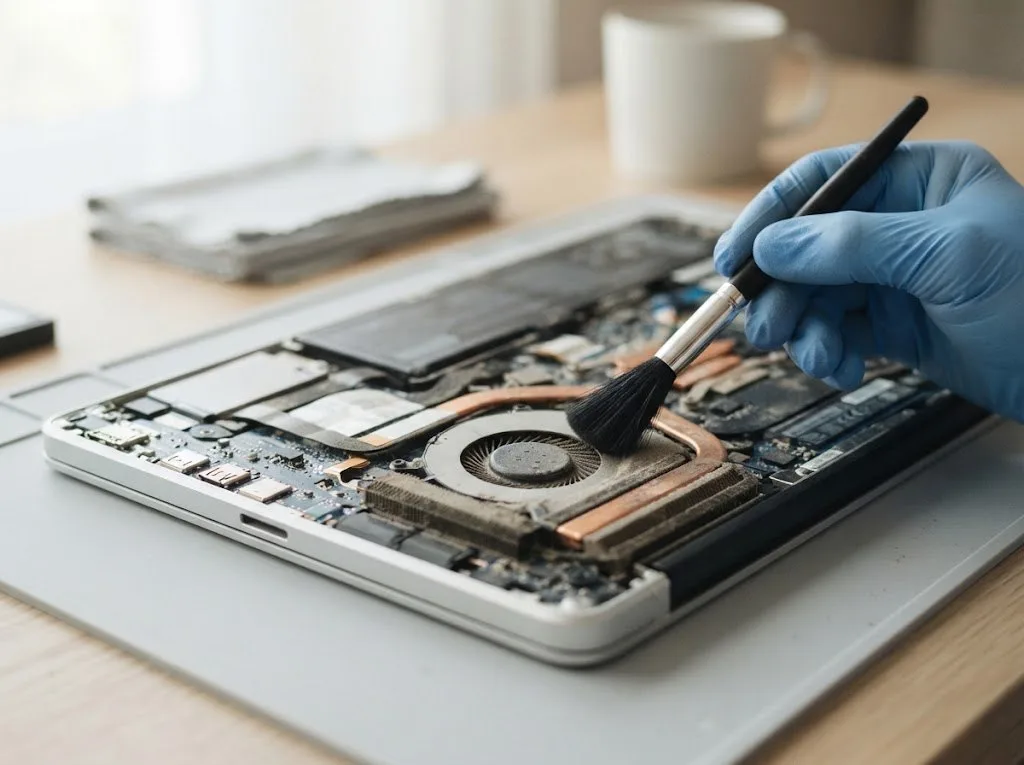
We open the MacBook, inspect the board under a microscope and check the keyboard, battery and connectors one by one, so the diagnosis names the exact damaged part instead of guessing. The microscope shows corrosion trails, burnt pins and lifted pads that stay invisible to the eye, and we photograph each zone before touching anything. The keyboard gets tested key by key, the battery is checked for swelling and voltage drop, and every connector is reseated and inspected for residue. Oxidation often hides under shields and connectors, so a visual check from outside tells almost nothing about the real damage. After liquid gets in, the engineer may need up to two days to map every affected line before quoting the work.
When the damage comes back a week later
A MacBook that worked for a week and then stopped is the classic delayed-corrosion case, and it usually means the liquid was never fully removed. The residue sat on the board, drew moisture from the air and kept eating the contacts until one line finally lost connection: charging stops, the keyboard drops keys, the display flickers or the machine stops booting at all. Owners often read that second failure as a new fault and treat it as a coincidence. By the time the second failure appears, the residue has had days to spread, so cleaning takes longer than it would have on day one. In our practice, the earlier the board is cleaned, the smaller the repair.
How We Diagnose a MacBook After an Accident
We open the MacBook, clean what the liquid reached and test the hardware before naming any repair. Here is what that process looks like, why the timing varies and what the check covers.
Free diagnostics in front of you
We run free diagnostics in front of the customer for 15 minutes, even if you decide not to repair, and show exactly what the liquid reached. The engineer removes the bottom cover at the bench, traces the path of the spill across the keyboard membrane and the logic board, and points to corroded pins as they appear in the light. You watch the whole check rather than collect a verdict at the door. Seeing the damage on the bench changes the decision for many owners, because a small spill on the keyboard often looks very different once the cover is off — a few sticky keys on top can sit above a green-furred connector underneath. Ask the engineer to photograph the board before cleaning; that image is your baseline if the same spot misbehaves months later.
Why water damage diagnostics can take two days
After liquid, diagnostics can take up to two days because we clean the board first and then watch how it behaves under load before naming the repair. The cleaning step removes residue from the affected area, and the hardware then goes back into the chassis for a run with the display, ports and battery connected. Some faults only surface in that window: a rail that holds voltage at idle and sags under demand, a sensor that reports correctly until the machine warms up. Rushing that step hides intermittent faults, and a fault that only appears once the machine is warm is exactly what comes back as a repeat failure. A straightforward spill often lands within the same visit; the two-day ceiling applies to boards with heavy contamination.
What the check covers
- Logic board: corrosion, residue and voltage rails are inspected under the microscope where the liquid reached.
- Keyboard: each key is pressed and the membrane is checked for sticky residue and shorts.
- Battery: cell health, swelling and connector condition are measured against what the machine draws.
- Display and cameras: backlight, True Tone and both cameras are tested for liquid trails.
- Charging and ports: every USB-C port and the charging circuit are tested for stable current.
Repair Options and What Gets Fixed on the Receipt
After a spill, the range of outcomes runs from a simple clean-and-dry to a board-level repair. Here is how we decide between repairing and replacing, and what gets written down before any screwdriver touches the case.
Repair or replace the MacBook
Most liquid-damaged MacBooks can be repaired, and replacement only makes sense when the board damage is beyond cleaning and the model is already old. The components liquid reaches first are the keyboard membrane, the trackpad ribbon and the power rails around the charging circuit — all of them serviceable. A logic board that took sweet tea usually needs ultrasonic cleaning and a few replaced components rather than a whole new machine. Age matters too: a MacBook well past its prime with a corroded board is a harder call than a recent model with localised damage. The decision usually turns on which components the liquid reached, not on how the machine looks from outside, so a diagnosis comes ahead of any verdict.
Original part or aftermarket
We offer a choice between an original component and an aftermarket one, and 64% of our customers pick the original because it keeps the device closer to factory behaviour. An original keyboard, battery or display assembly matches the tolerances the machine was built around, which shows up in key feel, True Tone and battery reporting. Aftermarket options cost less and arrive faster, and for a MacBook that is already several generations old they can be a sensible stopgap. What matters is that the trade-off in fit and lifespan is explained while you decide, not after — we show the new component in factory packaging ahead of installation so you can see exactly what goes in.
What is fixed on the receipt before work starts
We fix the price, the component, the turnaround and the warranty on the receipt in about two minutes, ahead of any work begins. That record names the exact item — original or aftermarket — the expected completion time and the warranty period, which lasts up to 1 year on our work. You sign it, we start, and nothing changes mid-repair without your agreement. A written record protects both sides, because a later disagreement about which item was fitted or how long the service should take is settled by the paper, not by memory. Ask for the old component back when you collect the device; keeping it lets you verify later that what came out matches what was written down.
After the Repair, Warranty and How to Get the MacBook to Us
Once the work is done, the device goes through a final check, comes back with paperwork, and can reach us in more than one way. Here is what that handover looks like in practice.
The 32-function check with the customer
After the repair we check 32 functions in about ten minutes, together with the customer, including the display, cameras, microphones, speakers, charging and network. The engineer runs each test in front of you rather than behind a closed door, so you see the same results we record. The display and its brightness are part of that pass, because liquid often disturbs the display calibration even when the panel itself survives. You tap through the checklist yourself where it makes sense, and the engineer confirms each item aloud. Running the check with the owner present means any function that behaves oddly is caught before the device leaves the bench, not after a second trip.
What the warranty covers
We give a warranty up to 1 year on the repair, and the device is returned with the receipt, the warranty card and the old component. The receipt names the exact item that was fitted and the turnaround we promised, so the terms are on paper from the first minute. If a replacement fails inside the warranty period, the claim is handled against that document, not against a verbal memory of the visit. Keeping the removed unit matters, because it shows which component was actually swapped and makes any later warranty claim straightforward. Store the old board or battery with the paperwork — a technician can compare it with the new one if a fault ever needs tracing.
Courier, waiting area and turnaround
You can bring the MacBook in, wait in our lounge with coffee and Wi-Fi, or call a courier across the city who arrives in about 90 minutes, free with a repair. The waiting area suits shorter jobs, and 72% of repairs are finished while the customer sits there. MacBook work after liquid is the exception to the quick turnaround: most such repairs take from one hour to a day, and board repair takes one to three days under the microscope. For those longer cases the courier option saves a second trip across Almaty — send a photo of the damage on WhatsApp first, and an engineer replies within five minutes with a price and a free slot.
Summary: Spilled liquid on MacBook, first 10 minutes
A spill is a race against time, and the right moves in the first hour decide how much of the MacBook survives. Here is the short version to keep.
- Power off and unplug: shut the MacBook down and pull the charger at once, then tilt it so liquid drains away from the keyboard and board.
- Never switch it back on: skip rice, a hairdryer or a warm battery, since none pull liquid out from inside the case.
- A working MacBook is not a closed case: corrosion keeps spreading across damp contacts for days, so a machine that boots today can fail next week.
- Sweet drinks need faster action: tea, coffee and soda leave sticky residue that holds moisture against the board, so they call for cleaning sooner than plain water.
- Get the damage named in writing: a diagnosis identifies the affected part, and a record of the part, turnaround and warranty protects the owner.