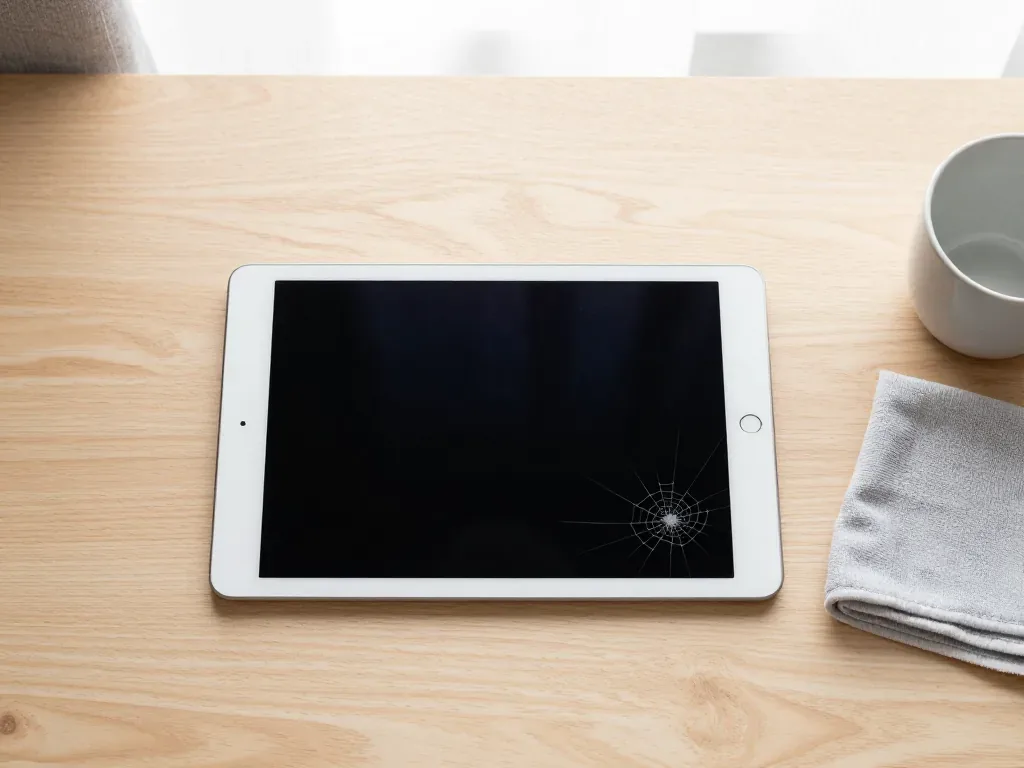
This tablet is thin, carries a two-layer OLED panel and puts Face ID on the long edge, so the faults we see most often cluster around the display, the power path and the port.
Cracks, lines and dead touch on the OLED panel
A cracked top layer, green or pink lines, dark patches or touch that stops responding are the most common display faults on this model, and they all point to the laminated module rather than separate glass. The Ultra Retina XDR panel stacks two OLED sheets with the touch sensor bonded on top, so a single impact travels through every one of them. Hairline cracks often stay invisible until the angle of light changes, while pressure marks show as bright spots that grow with each drop. Protective glass absorbs some of the energy but cannot stop flex inside the sandwich. Because the OLED sheets and the touch sensor are bonded into one unit, a hairline crack that still shows a perfect picture can spread under pressure — get it assessed before the panel itself fails.
Battery swelling, sudden shutdowns and charging faults
A battery that drains fast, shuts the tablet down at random or pushes the screen away from the frame is a swelling or worn cell, and on this model the cell sits glued under the display. The adhesive holds the pack flat against the chassis, so as the cell expands it lifts the panel instead of venting anywhere else. Users notice a bulge along one edge, touch that misreads near the swelling, or a charge that drops from 40 percent to zero in minutes. Random shutdowns under load and a frame that no longer sits flush belong to the same picture. A swollen battery should never be charged or pressed back into place — the pressure it puts on an OLED panel can crack the layers from the inside before any external damage appears.
USB-C, Face ID and board-level symptoms
A USB-C port that only charges at an angle, Face ID that stops recognising you after a drop, or heat with random restarts usually trace back to the port flex, the TrueDepth assembly or the board rather than the battery. The port flex carries the charging pins and sits exposed at the bottom edge, so lint, bent pins and cable strain hit it first. Face ID depends on the TrueDepth module aligned to the long edge, and a knock that shifts it kills recognition while the cameras keep working. Overheating with restarts points lower, to a shorted rail or a cracked joint. Port and Face ID faults are often the visible tip of impact damage — a drop that leaves the glass intact can still crack solder joints on the board, so the symptom and the cause rarely sit in the same place.
Screen repair on a laminated panel during iPad Pro 11 M4 repair
On this model the display is fully laminated, so replacing only the outer glass is settled differently than on older devices. Here is what actually gets swapped and what happens to Face ID and Pencil.
Why the glass cannot be replaced on its own here
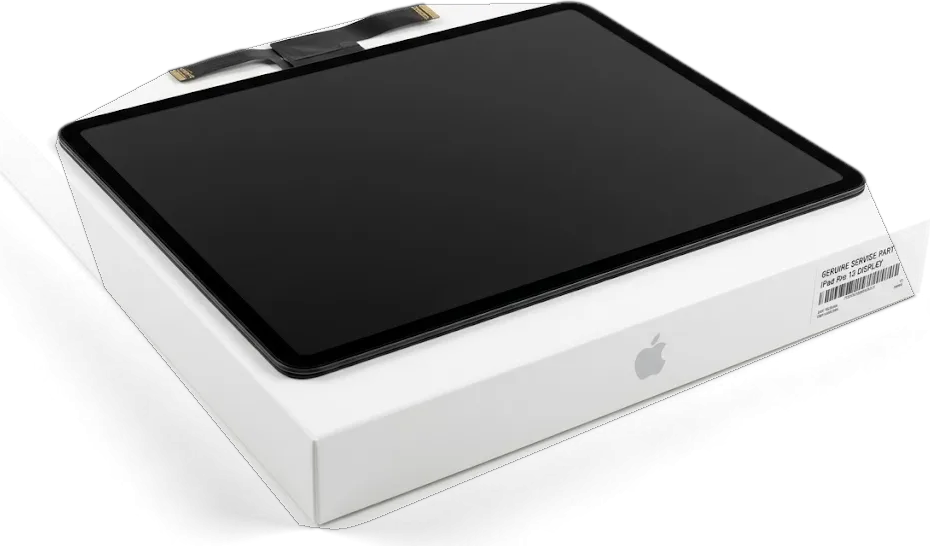
On the iPad Pro 11 M4 the cover sheet, the touch grid and the two OLED layers are bonded into a single module, so a cracked front means replacing the whole display assembly, not just the outer pane. The Ultra Retina XDR panel uses tandem OLED with an extremely thin adhesive bond between layers — there is no air gap to work in, and the digitizer sits directly beneath the top surface. Any heat or solvent strong enough to lift the front sheet also attacks the light-emitting layer underneath. Trying to separate the layers to save the panel usually damages the OLED emitters — which is why a workshop that promises a front-only fix on this model is either misreading the device or planning to reuse a compromised screen.
What happens to Face ID and Apple Pencil after a screen swap
We transfer the TrueDepth assembly from your old screen to the new module, so Face ID keeps working, and we test Apple Pencil Pro hover and pressure on the fresh panel before handover. This tablet has no Home button, so biometric unlock depends entirely on that TrueDepth assembly. Its components are paired to the board, so the safe path is moving the original sensor unit across rather than fitting a new one. We verify hover, tilt and pressure response against the digitizer before the device leaves the bench — ask any workshop which approach they use before you hand over it.
Display options we fit on this model
Two screen assemblies compared by panel and Pencil response| Option | Panel type | Pencil behaviour | Warranty |
|---|
| Original assembly | Ultra Retina XDR OLED | Full hover and pressure | Up to 1 year |
|---|
| Aftermarket module | OLED, tested batch | Hover and pressure verified | 6 months |
|---|
| Brightness | Peak, factory spec | Not affected | Up to 1 year |
|---|
How iPad Pro 11 M4 repair works at iServices
Our process is built so you can see every step — from a photo on WhatsApp to checking the functions together with the engineer. Below is what it looks like, stage by stage.
From a WhatsApp photo to a fixed quote on the receipt
Send a photo of the damage on WhatsApp and an engineer replies within 5 minutes with a price and a free time slot. Before any work starts, we fix the price, the part, the turnaround and the warranty on the receipt — the whole entry takes about 2 minutes. You choose between an original module and an aftermarket one, and the choice is written down exactly as agreed, not discussed later. A written quote before the device is opened protects both sides: it removes the "we found something else" conversation and gives you a document to compare against the final bill. Keep that receipt — it is the version of the deal that counts if anything is questioned afterwards.
Free diagnostics in front of you and the part in its packaging
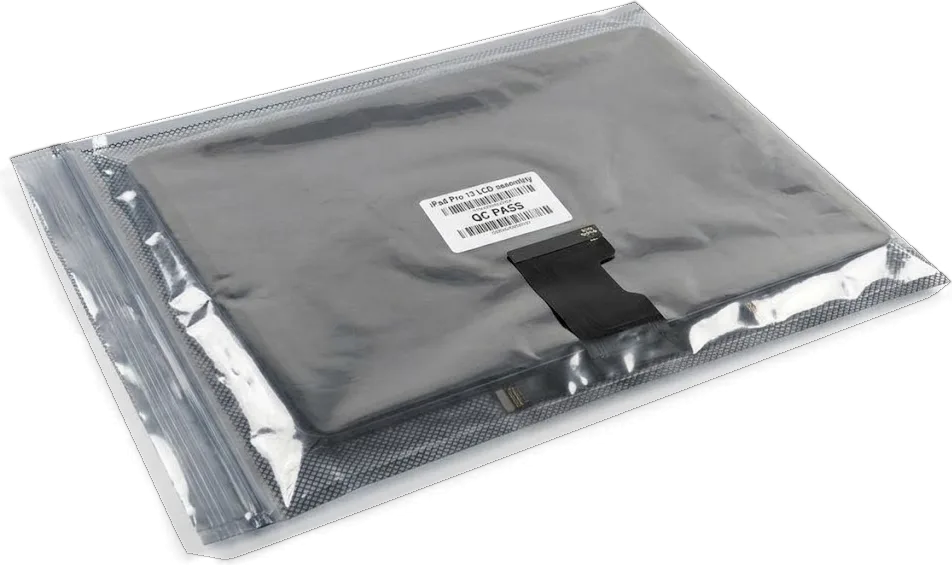
Diagnostics are free and take about 15 minutes in front of you, even if you decide not to repair, and the new part is shown in its factory packaging before it goes into the tablet. The engineer demonstrates the fault on your own screen rather than describing it, so you see the dead touch zone or the swollen cell yourself. Seeing the part sealed and the fault demonstrated on your screen is the simplest way to tell a real replacement from a cleaned-up original — a step worth insisting on anywhere you take the device. If the fault turns out to be board-level, we say so during the same visit and explain what changes.
The 32-point check and what you get back
After assembly we run a 32-function check of about 10 minutes covering Face ID, True Tone, cameras, microphones, speakers, charging and network, and you go through the key ones with the engineer before handover. True Tone and Face ID matter most on this model, because a poorly paired display module can leave either of them dead, and only a live test on the assembled device catches that. The old part, the receipt and the warranty card travel back with the device — keeping the removed module is your proof of what was actually replaced if anything goes wrong later. Ask for the old part even when you do not expect to need it.
Original or aftermarket parts and iPad Pro 11 M4 repair warranty
The component you pick for this device affects display brightness, how the cell behaves and the coverage behind the job. Here is how the two routes differ and what protection you actually get.
How original and aftermarket parts differ in practice
An original display keeps factory brightness and colour calibration, while a tested aftermarket module can differ slightly in peak brightness and tint; cells differ mainly in how they hold capacity over the first year. We show every new component in its factory packaging before installation, so you see exactly what goes in. On the OLED panel of this model the gap shows up in HDR highlights and white balance, where an aftermarket module may read a touch cooler. Both routes restore runtime on day one, yet capacity retention drifts apart with charge cycles. The distance between a good aftermarket module and a genuine one is smallest on day one and widest after months of daily use — which is why the choice matters more for a device you rely on than for a spare.
What the warranty up to 1 year actually covers
Every repair carries a warranty up to 1 year, recorded on the card you receive with the device, and it covers the component we fitted and the work we did. The document names the item and the term, and it is issued together with the receipt and your old component at handover. Workmanship claims — a loose connector, a display that develops lines, a cell that stops holding charge — are checked against that paperwork, and the engineer who did the job inspects the unit. Coverage follows the component, not the owner, so a device passed to a family member keeps its term. A warranty is only as good as its paper trail — keep the receipt and card together with the old component, since they are what a claim is checked against.
Choosing a part for your iPad Pro 11 M4
- Colour-critical work: choose the original assembly when design, photo or video work depends on accurate colour and brightness.
- Everyday use and media: a tested aftermarket module covers browsing, streaming and note-taking without a visible difference.
- Long-term ownership: if you plan to keep the device for years, the original assembly holds its characteristics longer.
- Battery replacement: both routes restore runtime; the original cell keeps capacity steadier over the first year.
- Budget-driven repair: an aftermarket module is a reasonable path when the device is a secondary or family unit.
Turnaround times and what we check before handover
How long the job takes depends on which part failed: display and battery work fits into a day, board faults need longer, and liquid contact can push diagnostics out further. Below are the realistic windows.
How long each type of repair takes
repair types against windows and final checks| Repair | Typical turnaround | What we check afterwards |
|---|
| Display module | From 1 hour to 1 day | Touch, True Tone, Pencil, Face ID |
|---|
| Battery | Same day | Charging, runtime, screen fit |
|---|
| USB-C port | Same day | Charging, data, network |
|---|
| Board-level fault | 1 to 3 days | Boot, heat, all 32 functions |
|---|
| Liquid damage | Diagnostics up to 2 days | Corrosion, circuitry, charging |
|---|
Waiting in the lounge or sending the tablet by courier
You can wait in our lounge with coffee and Wi-Fi while the work is done, or call a courier if you cannot come in; across the city the courier run takes about 90 minutes and is free with a repair. Most jobs finish while the customer is still in the building — 72% of repairs are completed in the waiting area, so a second trip is rarely needed. A courier collects the tablet and returns it to the same address once the engineer signs off, which suits owners at work during our weekday hours. Waiting on site is worth it for screen and battery jobs: you watch the part go in and test the tablet yourself before you leave, which removes the round trip if anything feels off.
Liquid contact and board work under the microscope
Circuit-level faults are repaired under a microscope, and a tablet that took on liquid is never charged before it is opened, since power on a wet board turns a cleanable fault into a dead one. Corrosion hides in connectors and under shields, so the visible symptom often appears days after the spill. When water is involved, diagnostics can stretch to two days — we trace residue across the logic board rather than swapping parts until something works. A full diagnostic right after the spill costs far less than waiting for corrosion to spread. If your iPad Pro 11 M4 repair in Almaty starts with a liquid story, say so on WhatsApp first: an engineer replies within five minutes and tells you whether to bring it in straight away or leave it off the charger.
Summary: iPad Pro 11" M4 Repair
A short recap of what decides the outcome on this tablet — the display type, the battery warning signs and the paperwork you leave with.
- Bonded display: the iPad Pro 11 M4 front is one sealed OLED module, so a crack is fixed by swapping the whole assembly rather than the glass alone.
- Swollen cell: a battery that pushes the screen off the frame should never be charged again — treat it as an urgent diagnostic case before the frame bends.
- Written quote first: ask for the component, the turnaround and the warranty in writing before anyone opens the device, then compare offers on those three lines.
- Keep the record: the old component, the receipt and the warranty card together show exactly what was swapped if a fault returns months later.
- Match to real use: colour-critical design work justifies the original assembly, while everyday browsing and video rarely reveal the difference.












 MacBook
 iMac
 Mac mini and Studio
 Apple Watch
 AirPods
 Apple Pencil
 Apple TV
 HomePod