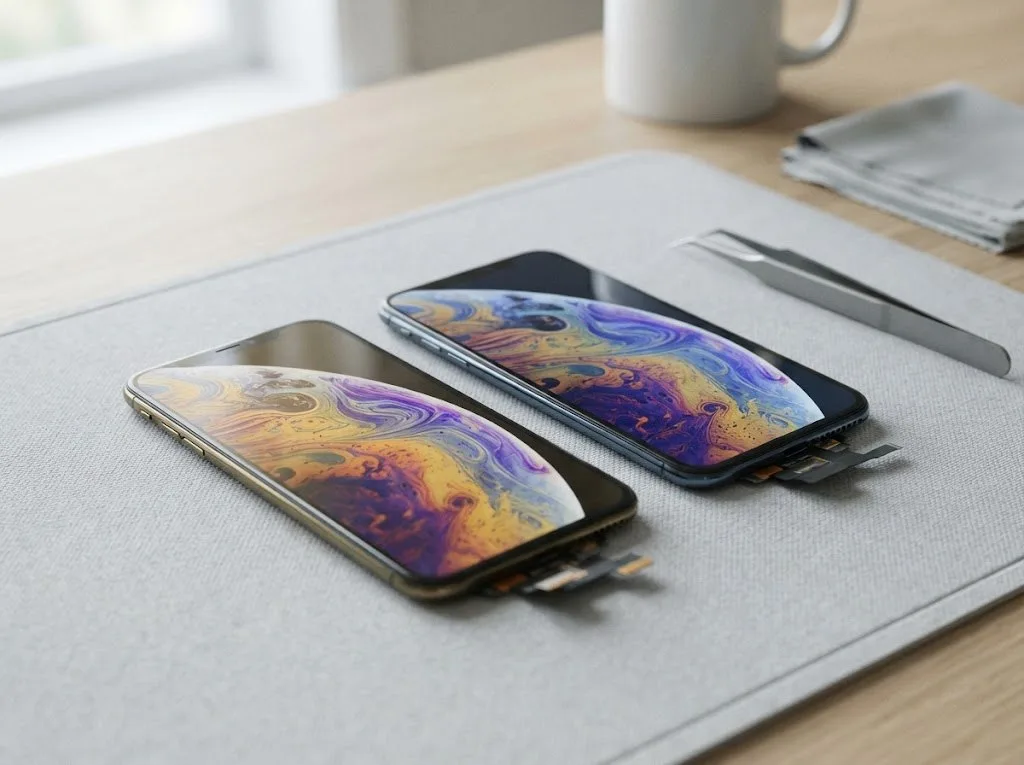
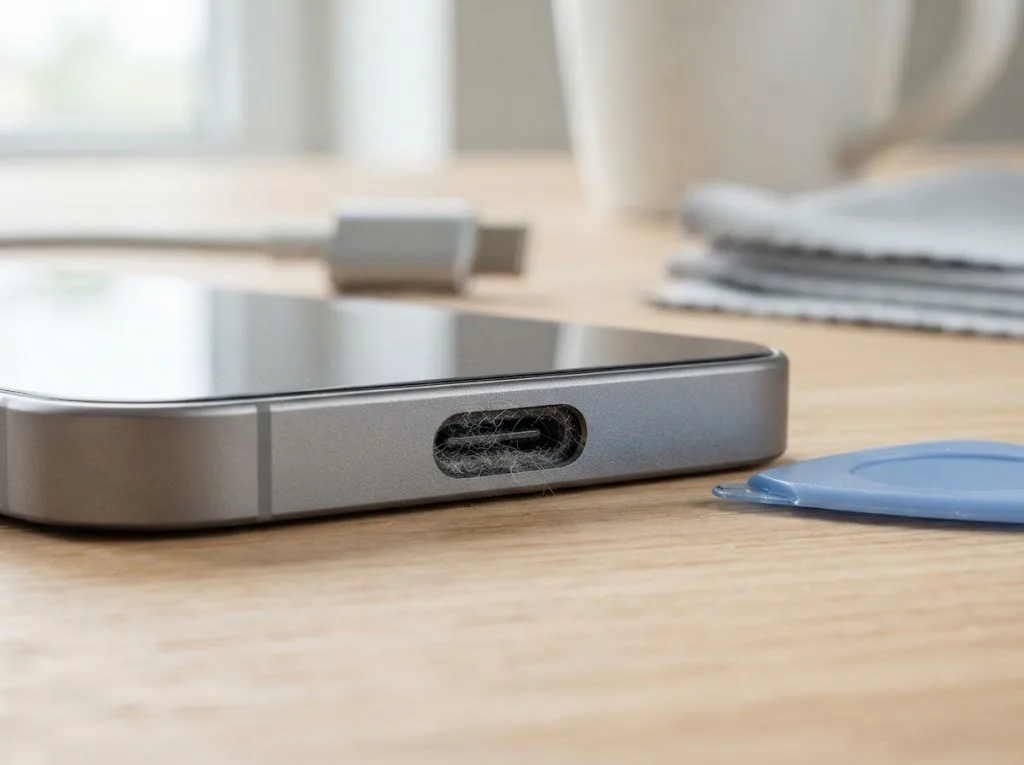
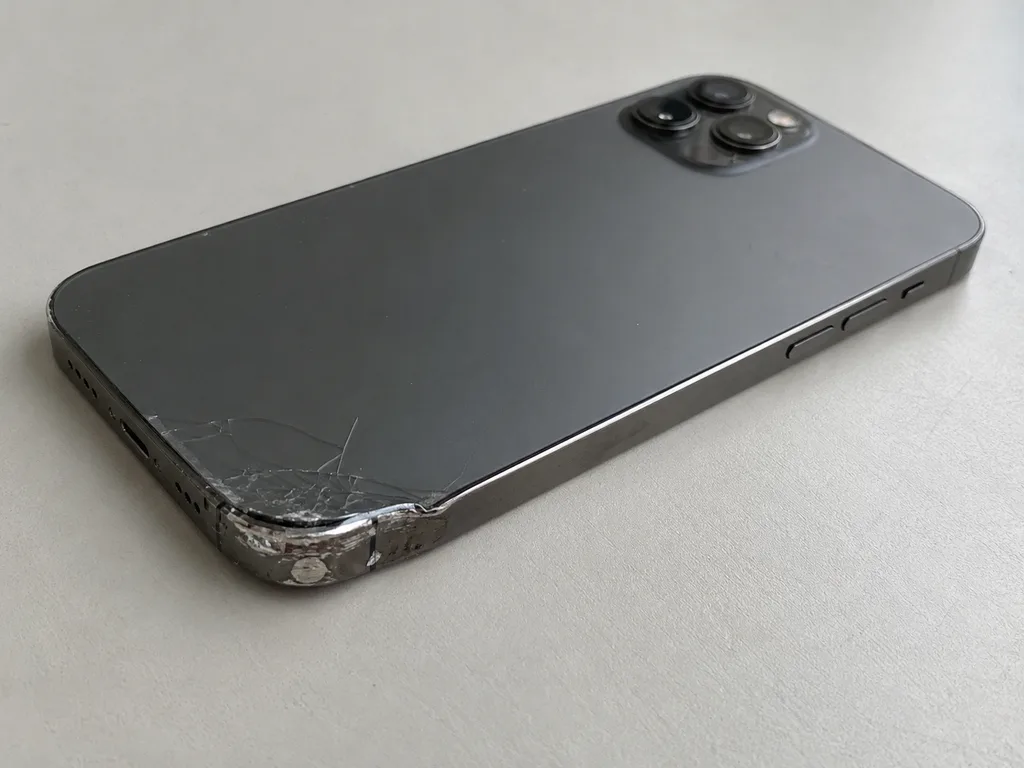
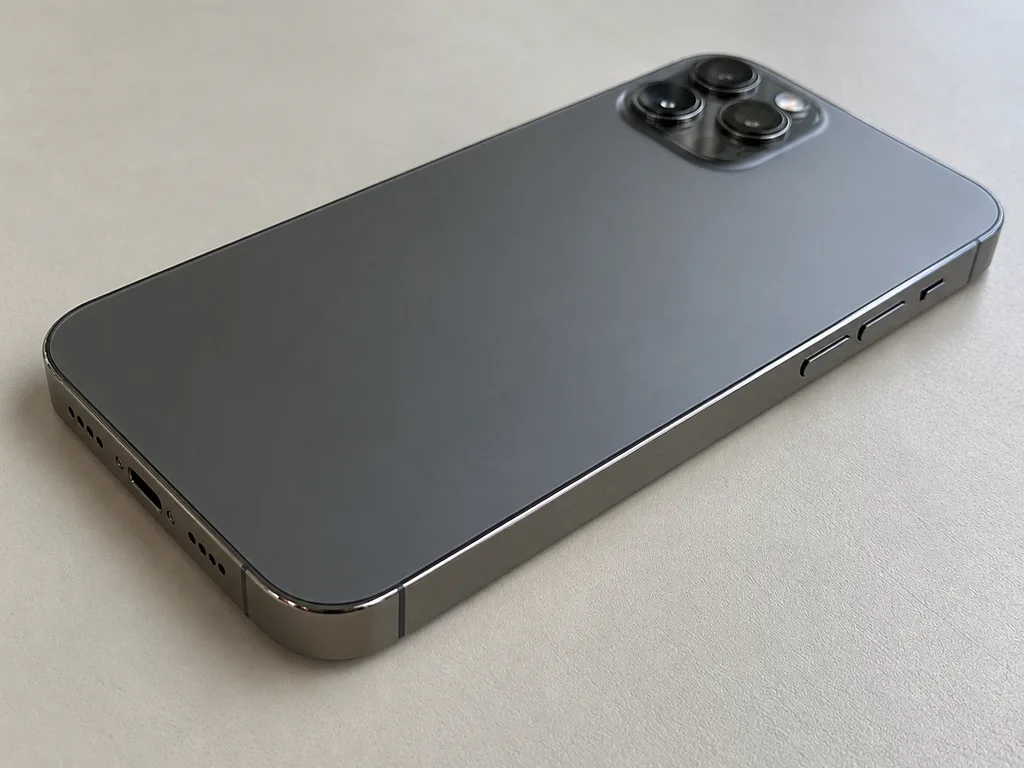
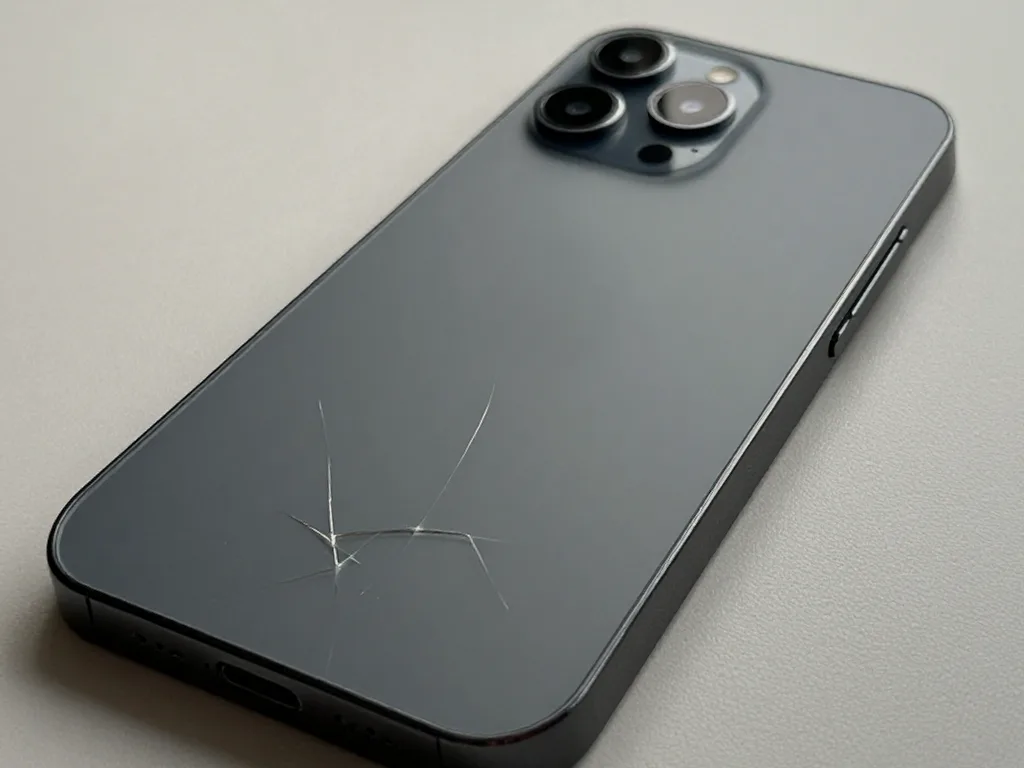
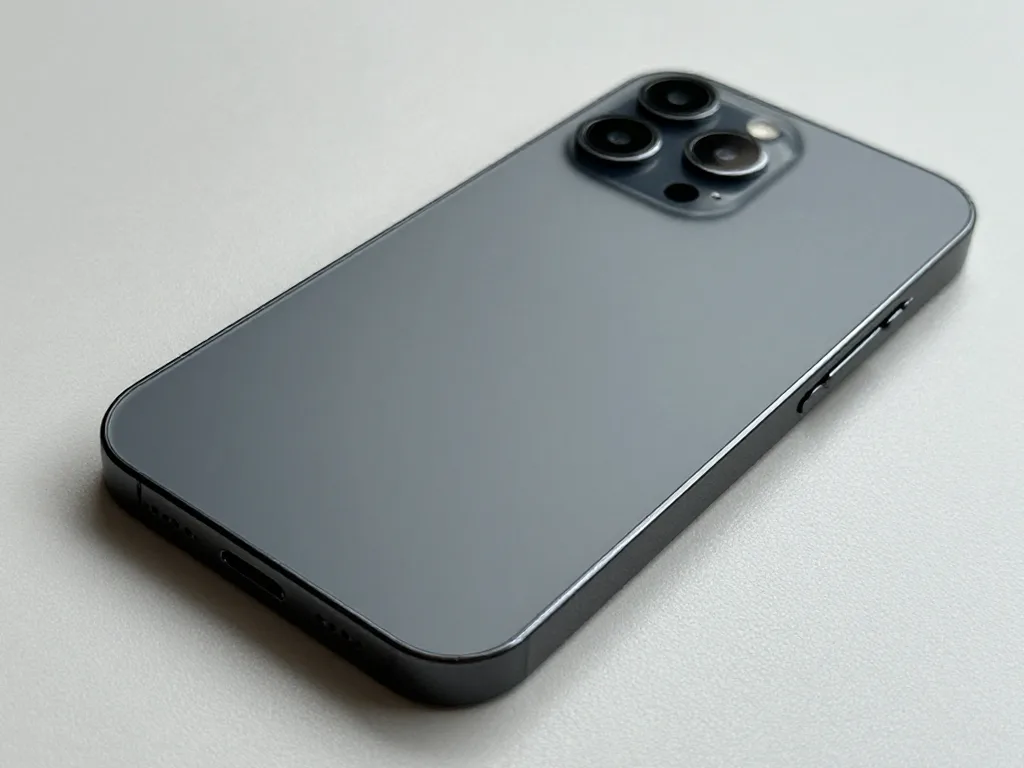
The decision is not about budget but about the frame. A cracked back with a straight frame is a glass-only job; a bent or dented frame means the whole housing has to be swapped.
Reading the Damage Before Anything Is Ordered
We lay the phone on a flat bench and check the frame with a straight edge during the free 15-minute diagnostics, so the choice between glass and housing is made on facts, not guesswork. The engineer runs a fingertip along each seam, presses the corners against the bench and looks for a gap where the back panel meets the rail. A frame that rocks under light pressure or sits uneven at one corner has lost its geometry, and no amount of fresh glass will pull it back. On models with a glass back, the rear pane is bonded directly to that rail, so any twist in the metal telegraphs straight into the bond line. A chassis that rocks on the bench or shows a gap at the seam will not hold new glass flat, so pressing a fresh pane onto a bent body usually cracks again within weeks.
Three Repair Options Side by Side
Three repair paths matched to different damage patterns| Option | When it fits | What is transferred | What we check afterwards |
|---|
| Back glass only | Cracked panel, frame straight | Nothing, panel is bonded to the frame | Wireless charging, cameras, flash |
|---|
| Whole housing | Dented or bent frame, deep scuffs | Board, battery, cameras, Taptic Engine, speakers, flex cables | Face ID or Touch ID, buttons, network, charging |
|---|
| Camera glass only | Broken lens ring, back panel intact | Nothing, ring is replaced on its own | Rear camera focus, flash, microphone |
|---|
How the Housing Is Built on Different iPhone Generations
The same crack looks like a different job depending on the model. Steel frames, glass backs and plastic shells each fail and come apart in their own way.
Steel, Aluminium and Plastic Shells and How They Fail
The iPhone 4s rear cover is held by two pentalobe screws and lifts off without heat, while the 5c uses a polycarbonate shell over a metal inner chassis that is swapped as one piece. Stainless rails on the 4 and 4s resist dents but scratch deeply along the antenna bands, and those strips have to be transferred to a replacement with care. Aluminium bodies on the 6 and 6 Plus bend at the volume-button side under pocket pressure, so a housing swap on those models is often a straightening decision as much as a cosmetic one. On the 5 and 5s the inserts sit inside an aluminium body, and a cracked insert alone does not always justify a full swap. Check the body for twist with a flat ruler before ordering any part — a bent shell will crack the fresh glass within months.
Glass Backs and Steel Rails from the 8 Onwards
From the iPhone 8 onwards the rear is a bonded pane so wireless charging can pass through, and on the X, XS and 11 Pro the rail underneath is stainless steel. The matte finish on the 11 Pro hides fingerprints better than the glossy surface of the XR, but it also shows scuffs from cases more readily, so colour matching matters on that generation. The wireless charging coil is glued to the inside of the rear pane and travels with the new part, while the Face ID assembly stays with the body and must be moved across intact. Once any housing is opened the factory water resistance is gone, and fresh adhesive seals dust and splashes but does not restore the original rating. Treat a resealed phone as splash-resistant only, and keep it away from pools and heavy rain.
How We Carry Out iPhone Housing Replacement in Almaty
The job starts before you arrive and ends with the old part in your hand. Every step is fixed on paper so nothing about the part or the timeline changes mid-repair.
From a WhatsApp Photo to a Fixed Receipt
Send a photo of the damage on WhatsApp and an engineer replies within 5 minutes with a price and a free slot, then fixes the price, part, turnaround and warranty on the receipt in about 2 minutes before work starts. You can choose an original housing or an aftermarket one at that stage — the component type goes on paper, not into a verbal promise. We open the factory packaging in front of you ahead of installation, so the shell you agreed to is the shell that goes onto the frame. Free diagnostics take 15 minutes with you watching, even if you decide against the repair afterwards. Because the component type is written down ahead of the phone being opened, there is no mid-repair upsell once the old housing is already off. This is how iPhone housing replacement in Almaty stays transparent from the first message to the finished job.
Bench Work, Waiting Area and Handover
We show the new housing in factory packaging before installation, and 72% of repairs are finished while the customer waits in the waiting area with coffee and Wi-Fi. The swap itself is bench work: the technician moves the board, cameras, sensors and buttons across, then checks that the frame sits flush and the buttons travel cleanly. Most jobs of this type are done inside the usual 20–40 minute window for common repairs, and the whole process from first contact to pickup usually takes less than an hour. A courier across the city takes about 90 minutes and is free with a repair, which matters when the phone is your work line and you cannot leave the office. You leave with the old housing, the receipt and the warranty card covering the work up to 1 year.
What We Check After the Housing Is Back On
A housing swap touches almost every internal connector, so the check afterwards is where a good job is separated from a rushed one.
The 32-Point Check We Run Together with You
After the repair we run through 32 functions in about 10 minutes together with you, covering Face ID or Touch ID, True Tone, cameras, microphones, speakers, charging, wireless charging and network. You hold the phone yourself while the engineer walks through each item: the front and rear cameras focus at every zoom step, both microphone grilles record a voice note, the loudspeaker plays it back clean, the Lightning or USB-C port takes a cable at a normal angle, and the buttons click with the same travel as they did originally. Wireless charging is the function people forget to test, and a coil that was not seated flat during reassembly will only show up when the handset is set on a pad. Ask to place it on the pad yourself and watch the icon appear — a two-second habit that catches a loose coil before you leave the waiting area.
What Comes Back with the Phone
- Receipt: the same document you signed ahead of work, listing part type and turnaround.
- Warranty card: covers the housing and the workmanship up to 1 year.
- Old housing: returned to you, useful as a source of small parts.
- Payment: Kaspi, bank card or cash, settled at handover.
Original or Aftermarket Housing and How the Finish Holds Up
Fit and colour are what people notice first, and the gap between an original housing and a good aftermarket one shows up in the details rather than the spec sheet.
Fit, Colour and the Matte Finish on the 11 Pro
64% of our customers choose an original part, and on the 11 Pro the matte back is where aftermarket copies most often read as slightly glossier or a shade off in daylight. We set the new housing against the old unit on the bench before installation, checking seam gaps, button travel and how the seams sit around the camera plateau. Silver and space grey are the easiest finishes to match, while gold and midnight green shift enough that the difference is visible in direct sun. On a matte shell the texture matters as much as the colour — a glossier copy catches light along the edges and gives the swap away faster than any tone difference. Colour matching is easier on silver and space grey than on gold and midnight green, so on those finishes it is worth comparing the new housing against the old one under daylight before installation.
Original and Aftermarket Compared
Two part options side by side by fit and finish| Property | Original housing | Aftermarket housing |
|---|
| Panel fit and seams | Factory gaps, flush buttons | Close fit, occasionally tighter seams |
|---|
| Colour match | Exact shade for the model | Very close, slight shift on gold and green |
|---|
| Matte texture on 11 Pro | Factory matte | Sometimes glossier under daylight |
|---|
| Long-term wear | Holds finish longest | May show scuffs sooner |
|---|
Summary: iPhone Housing Replacement
The decision comes down to the damage pattern, the phone generation and the part you pick. Here is what to keep in mind before you commit.
- Cracked glass, straight frame: a clean break with an unbent chassis is usually a glass-only job, while a bent or dented frame calls for a full housing swap.
- Generation sets the method: screw-held covers on the 4s give way to laser-removed backs on the 8 and newer, so the same crack means different bench work.
- Transfer, not just a shell: a swap moves the board, battery, cameras and flex cables across, which makes the post-repair check as important as the work itself.
- Water resistance is not restored: no housing returns to factory sealing once opened, even with fresh adhesive, so keep the device away from water afterwards.
- Part choice shows over time: original and aftermarket units differ mainly in fit, colour and how the finish ages, which matters most if you plan to resell.









 iPad
 MacBook
 iMac
 Mac mini and Studio
 Apple Watch
 AirPods
 Apple Pencil
 Apple TV
 HomePod