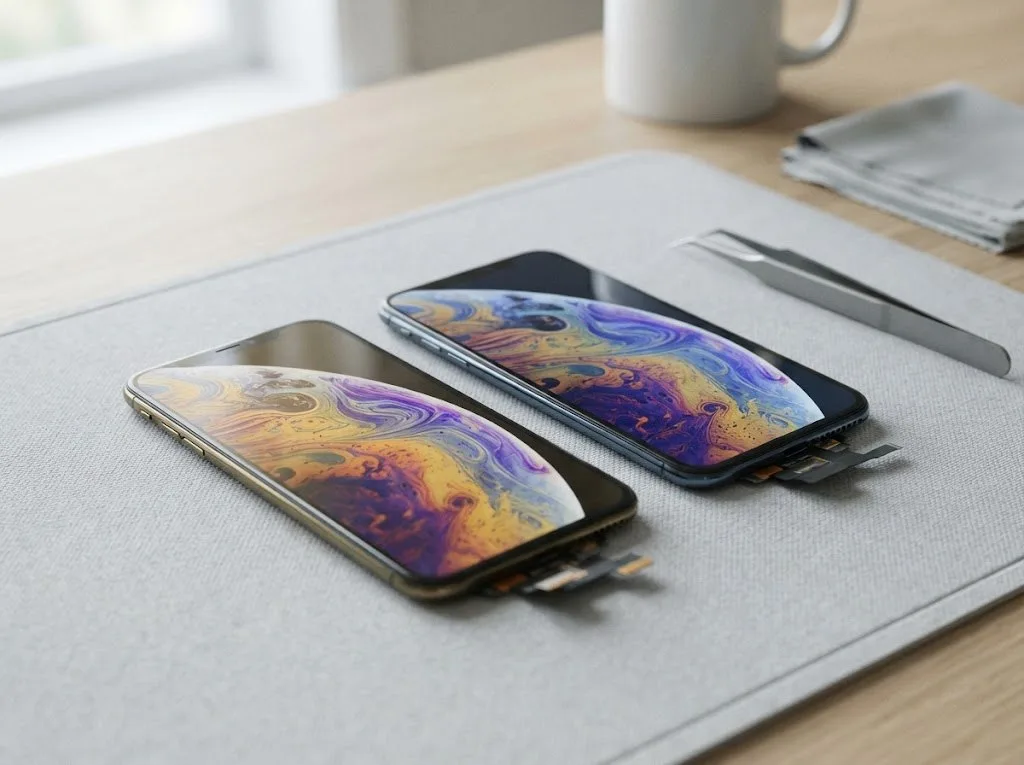
A crack does not automatically condemn the display underneath it. The decision rests on the state of the image and the sensor layer, not on how badly the front glass looks.
How to tell the OLED panel is still healthy
We examine the XS Max in front of you for a clean picture with no dark spots, lines or colour patches, and for a surface that responds to every swipe, edges included. A healthy OLED matrix holds even brightness from corner to corner, shows no green or pink tint on white backgrounds and registers input along the curved sides. The free check takes about 15 minutes and the engineer shows you what is broken on the screen itself, so you see the same pixels we do. A crack that runs over a working display is still only a glass problem, but a single dead strip or a bright spot means the matrix is already damaged and glass alone will not bring it back.
What we do if the diagnostics show a damaged panel
If the free inspection reveals spots, lines or a dead zone along the edge, we say so before any work starts and explain that the whole display assembly has to be replaced instead of the glass. The part, the turnaround and the warranty are written on the receipt before we touch the phone, so the scope never changes halfway through the job. Deciding this on the spot, with the device in your hands, prevents the worst outcome of a rushed repair, where glass is bonded to a screen that was already failing and the result disappoints both sides. A bonded sheet over a dying OLED also traps heat and shortens whatever life the display had left, so the honest call saves you a second visit.
How iPhone XS Max glass replacement works step by step
The work runs from lifting the module out to bonding fresh glass onto the OLED stack with optical glue. Each stage on this assembly rewards patience — and punishes shortcuts.
Why the OLED panel on the XS Max needs a careful hand
The XS Max carries a thin organic light-emitting matrix that is far more sensitive to heat and separation than the LCD panels in iPhone 6 through 8 and the XR. On this assembly the front glass sits directly over the light-emitting layer, so a hot plate that is fine for an LCD will warp or kill the pixels in seconds. The cracked layer has to come off at a controlled temperature, with the wire running along the edge kept clear of the blade. That is why the same crack on an older LCD model and on an XS Max are not the same job, and a shop that treats them identically is a warning sign rather than a shortcut. That is also why iPhone XS Max glass replacement in Astana calls for a technician who works with this OLED stack every day.
The stages from cracked glass to a bonded screen
- Module removal: we open the phone, disconnect the battery and lift the screen out without stressing the flex cables.
- Layer separation: the broken sheet comes off the panel on a temperature-controlled plate, with edge wiring kept clear.
- Glue cleanup: every trace of old bonding material is cleared so the new sheet sits flat with no shadow underneath.
- Optical bonding: replacement glass goes onto OCA film and into the vacuum laminator, which pulls trapped air out.
- Final cure and assembly: the bonded screen is cured under pressure, checked, then closed back with fresh sealing.
What stays untouched after the new glass goes on
Only the top layer changes, so every function tied to the display matrix and the housing stays exactly where it was. The work is about the surface, not the electronics underneath.
Face ID, True Tone and 3D Touch after the repair
Face ID, True Tone and 3D Touch keep working because the sensor stack and the True Tone module stay with the original panel, and we test them together with you at pickup. The front camera and the dot projector sit in the top bezel, untouched by the glass swap, and the pressure layer that reads 3D Touch is fused to the display rather than to the cover. Our engineers run the full 32-function check — Face ID, True Tone, cameras, microphones, speakers, charging and network — in about 10 minutes before the device goes back to you. These functions live in the display and the housing rather than in the glass, which is exactly why a glass-only job is worth doing when the OLED stack is healthy.
Screen protector versus the front glass of the module
A screen protector is a thin film you stick on top, while the front glass is bonded to the display matrix and cannot be peeled off at home. The film takes scratches and light knocks, costs little to swap and leaves no residue when lifted, which is why many owners treat it as a consumable. The real cover glass is glued to the digitiser and the display with optical adhesive, so lifting it means heating the assembly and cutting the bond with a thin blade. If just the protector is chipped, replacing the film is enough, but a crack you can feel under a fingernail usually sits in the real glass and needs the assembly opened.
Checking the result before you leave the workshop
Acceptance runs roughly ten minutes and happens together with the engineer, so no disputed points are left behind afterwards. You see each test on your own device before the job is closed.
A short checklist for touch, light and dust
- Touch to the edges: drag an app icon slowly into all four corners, since dead zones most often sit at the frame.
- Trapped specks and bubbles: tilt the display under a lamp and look for a faint halo that a bright screen hides.
- Backlight evenness: open a plain dark image and scan for brighter patches near the edges.
- Cutouts: confirm the glass sits flush around the camera and sensors with no lifting edge.
- 32-function pass: we run Face ID, True Tone, cameras, speakers, charging and network with you in ten minutes.
Why a crack left alone tends to spread
A crack keeps growing because any press and any temperature swing works the fracture deeper, and the open line lets grit and moisture reach the matrix. The front glass on the XS Max is bonded to the OLED panel across its whole surface, so a chip at one edge transfers stress into the layer underneath with each pocket carry. Moisture is the quieter problem: a single warm-to-cold move pulls condensation into the hairline, and the trapped film slowly clouds the pixels along the break. Grit behaves the same way, working into the gap and scratching the polarizer as the shards shift. Waiting rarely saves the panel; the longer a broken XS Max is carried around, the higher the chance the repair moves from glass to a full module.
Turnaround, paperwork and warranty on the job
The part, the turnaround and the warranty are fixed before any work begins, so the final bill does not drift while the phone sits on the bench.
Glass or full module at a glance
what each repair option swaps out and keeps| Option | What is replaced | What stays original | When it fits |
|---|
| Glass only | Front glass and OCA layer | OLED matrix, touch layer, Face ID | Image and touch are clean |
|---|
| Full module | Whole display assembly | Housing, Face ID module | Spots, lines or dead touch zones |
|---|
| Glass plus frame | Glass and bent frame | OLED matrix, touch layer | Frame is dented at the crack |
|---|
What the receipt and warranty card cover
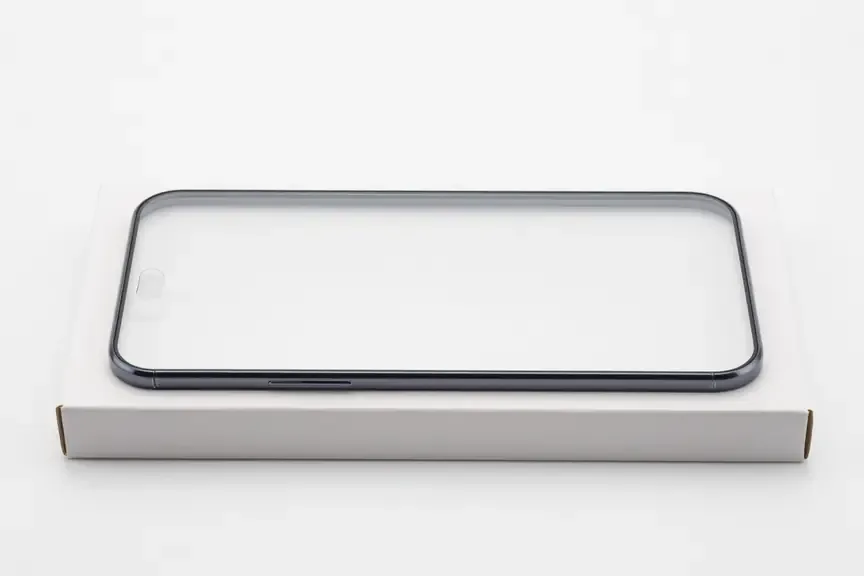
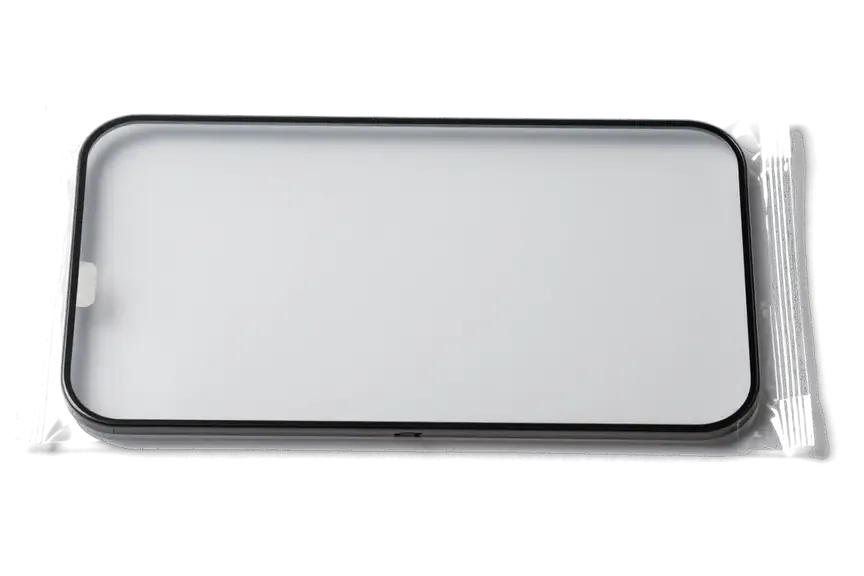
We fix the part, the turnaround and the cover terms on the receipt in about two minutes, and the job is guaranteed up to 1 year. A photo of the damage on WhatsApp gets a price from an engineer within five minutes, so you know the figure before you travel across the city. The slip records whether the glass is original or aftermarket, how long the work takes and what is covered — the new part is shown in factory packaging before it goes on. You leave with the slip, the warranty card and the old glass, which matters if you ever need to prove what was actually changed inside the device. Keep that paperwork with the phone — a claim moves much faster when the number matches the serial in front of the engineer.
Summary: iPhone XS Max Glass Replacement
A short recap of the points that decide whether the XS Max needs new glass alone or the whole module, and what to verify on the finished screen.
- Glass-only repair fits: when the picture is clean and the digitizer responds across the whole surface, the front layer can be swapped on its own.
- Full module is the honest option: spots, lines or a dead input zone mean the panel underneath is damaged beyond the cover layer.
- XS Max separation is delicate: the display assembly on this model is harder to lift cleanly than the LCD screens fitted to older models.
- Original screen keeps its features: Face ID, True Tone and 3D Touch stay in place because they live with the panel that is never replaced.
- Final check matters: test the edges, look for dust under the new glass and take the receipt and warranty card before leaving.







 iPad
 MacBook
 iMac
 Mac mini and Studio
 Apple Watch
 AirPods
 Apple Pencil
 Apple TV
 HomePod